Chủ Nhật, 29 tháng 11, 2009

Choosing Big Lights: AlienBees

The last installment of the Big Lights series is a look at AlienBees, a very popular line of studio strobes available in the US -- and recently, in Australia/NZ. But before I get into them, I will preface the post with this:

Early this fall when it came time for me to pull the trigger, I was having a very difficult time deciding between the Elinchrom Quadras and the Profoto Acute line. So I decided to go with a very comprehensive set of AlienBees.

Confused? Lemme explain…
__________


An Inexpensive Way to Learn

Having spent a significant amount of time deciding on which line of flashes I was going to marry, I realized that my main unknown was not so much the gear itself but rather my not knowing what kind of a big lights photographer I was.

My experience with the bigger flashes falls mostly in the neighborhood of nuking large areas -- gyms, large interiors, etc. And that is not the kind of thing I want to do, going forward.

I had grown much more comfy with my SB's than I was with my WL 600s, and that scared me. Not from a standpoint of inexperience but from that of not knowing exactly how to distribute what would amount to a big chunk of cash when buying lights.

So I decided I would date the AlienBees before deciding which flash system I wanted to marry. And who knows, if the AlienBees proved sufficient my wallet would come through the process largely unscathed.

And not knowing what I wanted, I bought ... everything.


Cheaper by the Dozen

By themselves, the lights and modifiers are inexpensive. But there are also quantity discounts to be had. Buy four flashes, as I did, and you get 20% off of every accessory you purchase at the same time. Which almost makes them free to test drive.

This is because, unlike your late-model digital camera which just lost $100 in value as you read this sentence, flashes hold their value very well. And new gear bought at a 20% discount will pretty much get you your money back on eBay whenever you are ready to sell. Which was my plan.

I bought three AB800s, an AB1600, stands, booms, strip boxes, a soft box, beauty dish, grids for the boxes and dish, tele reflectors -- pretty much everything that was for sale on the site, it seemed.

I did skip the remotes, as I am already full up on PocketWizards Plus II's. But when I was done I still had not managed to rack up a $3,000.00 total, as the 20% off added up to some pretty big savings.

And why not go crazy? My thinking was (and still is) that I could use them for months at almost no net cost. And if I liked them enough, I was done with my flash search.

It was a pretty heady day, getting the contents of a full studio delivered to the front porch by the UPS man. And over the last few months, I have learned a lot about AB's -- and about myself as a lighting photographer.


Likes, Dislikes

There is a lot to love about the ABs. At the top of the list, of course, is price.

You can get an AB800, with reflector, power cord and sync cord for $280.00. Which is about what it costs to see a movie in New York City. You can get the AB400 for $55 less, but that is a very small difference for one full f/stop. My advice is to skip it and go for the AB800.

This is ridiculous, silly cheap for a studio flash. So much so, in fact, that it has sort of blown the curve of what people think is an appropriate amount of money to spend on a big flash. Paul Buff sells direct only and manufactures by the boxcar load. He has created an entirely new business model in the industry.

Are they built like a Mercedes? No, they are not. But their service/repair policy is so generous that it does not really matter for many people. And they are sufficient for most uses, and that is what matters to their owners.

Buff also extends that "built good enough" ethic to his modifiers, with mixed results. Soft boxes, the dish, grids, and many other items I have found to be first rate and surprisingly heavy duty. The stands are serviceable, but are not what you would call confidence-inspiring. Also, his standard reflectors are ingeniously designed to accept a 7" grid without an accessory clip. But I would be happier if they were parabolic, rather than conic.

In short, the ABs allow you to jump in the pool for cheap. Try stuff -- heck, try it all -- and see what you end up using and/or liking. I especially like the Vagabond II, a $300 battery pack and pure sine wave inverter which will run (3) AC-powered AB800s on full power for 300 pops.

I bought two of them. I was like a shark in chummed waters -- I got that crazed look in my eyes that my wife gets when Ann Taylor has a 75% off sale at the mall.


What You Won't Hear

While I absolutely recommend experimenting in the shallow-priced AB waters, here is one thing you will not often hear said among AB owners:

"I just love the quality of the light..."

You hear that about Profoto, Elinchrom, Hensel, Broncolor, etc., But when AB/WL people start talking they usually come down to price and/or portability.

And you are not going to hear me rave about the gorgeous light quality either, because ABs do have a bit of quirkiness to them in that department. I can't quite put my finger on it or quantify it, other than to say that I am sometimes a little surprised by what I get from them.


So of course we did some testing. Here is a series, shot all of the way up and down the power range of a single AB800. They are not dead on, but neither are they grossly inconsistent. Maybe it's a UV thing? I really don't know.

And don't get me wrong -- I have been shooting assignments for months with these things with no complaints. And I still do not know if it is the lights themselves, or me not being fully used to them.

There are people (usually from expensive, prestigious photo schools) who turn up their noses and reject the AlienBees out of hand. That's ridiculous. They are the number one selling brand of studio flash, and for good reason. Similarly, there are people who are just as rabid in their support of the units.

I suspect that the truth lies in the middle somewhere. They are an amazing value, to be sure. But they are not the equivalent of a high-end Broncolor system, either.

And frankly, for the money I can live with a little quirkiness. I have some On Assignments coming up on which I used the AlienBees, so I will let you judge for yourself. It is a very subjective thing, light quality.


Want vs Need

What do I want? That's easy -- I want everything.

Which is pretty much what I bought. And exactly what I would not have been able to do with, say, Profoto. Not without knocking off a rich relative a commercial loan, anyway.

But what do I really need? That's a different story.

And that has been the most valuable part of my AlienBees experience -- learning what I need in a big light system as opposed to what I want.

Here's what I found out: Ninety percent of the time I shoot, I am going to be making a portrait and using two light sources. This is proving to be a transportable and predictable workflow from my speedlight shooting. Heck, it is probably because of my background working out of a waist pack that I have evolved that way.

Generally, it will be a restricted key and an on-axis fill of some kind -- ring, light off of a white wall behind me, umbrella behind the camera, whatever. Or maybe I will use ambient as a base and use one light as a key and other as a separator light. Usually as a rim light or a light on the background.

While sometimes I will use a third source, that is surprisingly rare. But having the third source gives you backup on the first two, which is very important. Any system you design should leave you without a single point of failure. Which is one reason I gravitate to monoblocs over pack-and-heads. And why six SB-800s in a small bag are more useful to me than one or two big monos.

Occasionally, I throw a lot of light sources at something. Just once in the last three months, shooting social media headshots for a local financial company, I used five sources. (But that was 3 AB800s, an AB ring flash and an SB800.) So maybe if I went with more expensive lights, I might have to miss out on an occasional job. Or just have to shoot differently. Or rent.

As an aside, the shot above was done using the three lights visible in the frame, and two more. The center light lit the background. The side lights lit each other. There was on-axis light from a ring. And an SB-800 on the ground shot a little up-light kicker to define the lights.

I may stay with the ABs, and I may not. But for less than the price of a single Profoto Magnum reflector, I have essentially been able to sort of "rent" a huge set of lights, stands and mods for months. That rental fee (net buying/reselling costs) was recouped many timed over on my first assignment with them. Which is why I am so pleased to have used them to discover how I want to light.


Learning from the Experience

Using what I learned from my drunken AlienBees gear orgy, I could now estimate with more confidence what I would need to buy should I decide to go with, say, Profoto.

I would want an AC pack, three lights (two regular heads, one ring) some pretty specific mods, and battery-powered packs to power at least two heads. And with the year-end specials Profoto is running, I am actually giving serious thought to pulling the trigger. If that seems strange, remember that I bought the ABs a while back, and that part of my reason in getting them was to evaluate both them and myself as a lighting photographer.

Here is the 40th Anniversary deal that is making me drool for Profotos: If you buy an Acute 600B (battery unit) or an AC-powered value kit, they throw in $1000.00 worth of accessories. Different countries have slightly different rules on the promo, so check if yo are interested.

This bonus appears to be stackable, too. So I could get two 600B packs, and an Acute 1200 value kit. For under $8k USD, that would give me two heads and the ability to run them on AC or battery power. My only single point of failure is the AC pack, and that is covered by the battery units.

And with the $3k USD in free accessories, I could get extra battery modules, a ring light head, a soft ring reflector (working with the Moon Unit has made that a must) grid reflectors and a Magnum reflector. I could get by with my ratty, 20-yr old White Lightning 7" grids that are pictured above. That is a setup I could live with for a long time. And I never would have been able to know that with any confidence without using a wide variety of AlienBees gear for several months.

Would I drop $8k for that? Absolutely.

And I am less concerned about the up-front price than I am about really knowing what gear I want to settle into. This is long-haul stuff -- a marriage. And I still have a month to decide before the special expires.

(Curse you, Profoto, for making the deal last up to the last minute of tax-spending season. That was evil. It's like a month-long test of fortitude, taunting me until New Year's Day.)


Back to the Bees

Do I regret jumping on the AlienBees? Not for a second. They have been very serviceable (not to say inspiring on all counts) and have provided some very valuable clarity for essentially no net cost should I decide to change horses. And I very well may stick with them for the long haul. I haven't decided yet.

If you have access to them (the AU/NZ distributorship is selling to surrounding Asian/Pacific countries, it appears) you can hardly go wrong as an entré into bigger lights. And given that they all have built-in slaves, they will definitely play nicely with your existing speedlights. (AB becomes main light, speedlights become fill/rim/background, etc.)


[UPDATE: The AU distributor of AlienBees confirmed that they are shipping to different countries, which will be good news for some of you who are outside the US.]


They are just so deliciously inexpensive. And with the (upcoming) "Einstein" versions, ABs get even more interesting as the light color issues are supposedly vastly improved. A lot of other improvements coming, too. I'll be keeping tabs on that.


Getting off of the Couch

Yeesh, I feel like I just went through a therapy session. And believe me when I say that is an honest a look as I can give you into my thought process on buying personal lights. And six months after I started, I am both well-equipped and yet strangely in limbo as to what I will do next.

So in some twisted way, I hope that this has been of at least some help. Hell, it probably just left some of you more confused. I am a little conflicted in that I now know enough to have prompted some questions I did not know to ask at the start of the process.

And I hope you AB/WL owners will sound off as to your experiences in the comments, good or bad. This is too important a decision to go on just one person's say so. Your opinions certainly will help others make better decisions.

Please share them with us.

Thứ Năm, 26 tháng 11, 2009

On Assignment: Planes and Arrows

As part of a long-term project I am working on with a local school, I popped into the gym after school recently to shoot archery practice. And it brought to mind a quickie tip for lighting big spaces.

A gym is a big-volume place, full of ugly light. You can't hope to light the whole thing very effectively with a few speedlights. But you can light selective planes and create the illusion that large, 3-D areas are lit -- even if you can only place lights at the periphery, lest your lights get skewered.
__________


Always start with a first look at the ambient. That's what I always do when assessing an area to light. A quick shot on auto exposure and daylight balance lets me know how much ambient there is, and what color it is.

Answer: Not much, and puke green. Perfect.

The auto-ambient is 1/15th of a sec at f/5 at 200 ISO -- pretty dark. And honestly, the darker a big room is (within reason) the better as far as I am concerned. With big areas, I want to give myself a friendly aperture to be able to hit with strobe when I build it back up.


Step two, is to knock out that ambient while leaving myself as much ability to light as possible. So, go to my sync speed (1/250th) and close down the aperture just until the bad things go away. 1/250th at f/6.3 is plenty dark. In fact, I probably still have a stop or so of leeway, in case I need to adjust my strobes' exposure by remote control by just tweaking my aperture setting later.

Just enough, but not too much on your new, ambient-killing exposure. I could easily nuke ambient with f/16 at 1/250th, but then I would have to light it to that level. Not an easy thing to do with speedlights at distance. Make life as easy on yourself as possible.
__________


The trick to working with speedlights in a volume this big is to realize that you do not have to light that whole volume. Just light the planes you are going to shoot -- be they walls, targets, people or whatever.


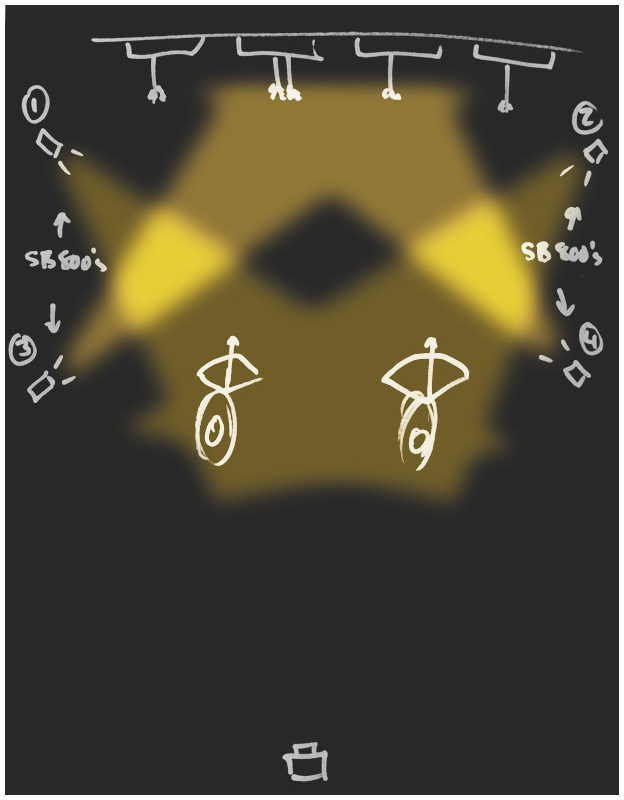
Case in point: Strobes #1 and #2 are lighting my shooters. Not much -- just enough to give them a little wrap detail and keep them from being a sillo. And you could easily light this whole thing with just two flashes if you were cool with the shooters going black. That's a pick 'em, or an easy out of you did not have enough flashes.

The two lights nearer to the camera (#3 and #4) are lighting the targets. I aimed the left flash at the right target area and vice versa, for even coverage.

Setting my flashes on 1/4 power at a 105mm throw, I can easily light up the targets at a significant distance. Ditto for my archers.

Another consideration here is that my lights are lighting both shooters and targets without being in the line of fire. I thought about placing them between the shooting alleys near the arrows' flight paths. Then I watched some of the shooters warm up. Ummm… No.

(They aren't making SB-800s anymore.)

And not that this light is anything major special, either. But remember the sickly pea soup we were in a few minutes ago -- it is that difference that is important to me.


Once we have lit the two planes, I can use the same setup to grab a detail shot, too. And it looks completely different with a longer lens -- almost as if that (now visually compressed) space is not even there.

If I want to adjust the exposure (liking this one a little more saturated) that's an easy fix by varying the aperture. No need to adjust the actual lights, as the whole thing is built on flash.

Your aperture is now your volume control.
__________


Same Principle, Different Approach

This project is activity-driven as far as subject matter goes. But the important part to me is producing a series of portraits of middle schoolers who are mastering their environment. The project will ultimately be aimed at incoming 6th graders, who are looking at middle school with mixture of garden-variety fear, and total, unadulterated fear.

So after the practice, I grabbed a portrait of the best archer in the group. And just like the above photos, this one is built with lighting on planes -- albeit in a different sense.

Their gear is pretty spartan, with nylon reusable targets and arrows of rather dubious fletching. We used three of the better arrows, and posed our archer against the target. There were only a couple of minutes to shoot, as class was ending and he had to go.

The target is much lighter in tone (especially at the edges) than is the archer, and I wanted to switch that relationship around, to place emphasis on him.

In the same way we can light planes, we can choose to exclude them -- even if they are practically adjacent. The target is lit by an on-axis (or nearly so) umbrella placed behind the camera. By lighting him to two stops down, we provide fill on his face and take the target down to saturate the faded colors while taming the white edges.

Two birds killed with one stone, we light the face next.


As you can see above, even though his face is right next to the target, we can light both planes separately by using a grid on his face and feathering it away from the target.

The important thing to remember is not to aim it at his face, but rather in front of his face. Just skim him to the front, and you can use the edge of the gridded beam to light his face without hitting the target.

(You could also gobo off the light to get this effect, with slightly different results. But I like the way the edge of the beam looks on a face.)

So, we are lighting a face on a completely different plane that is the lighting on the target which is just a few inches away. This means we can gel the face but not the target, which is exactly what is done here. A 1/4 CTO warmed up the flesh tones just a tad, without coloring the background at all.


Plane and Simple

By thinking of your lighting zones as planes, you can bypass large amounts of unneeded dead space. Or you can also be picky about just where your light goes and where it doesn't.

And the efficiency of lighting on planes helps you to easily overcome yucky ambient in large, dark spaces.
__________


Next: Prep Quarterback

Thứ Tư, 25 tháng 11, 2009

Giving Thanks in a Tangible Way

For those of you outside of the US, today is the day we celebrate Thanksgiving. It's a time to pause and be thankful -- and increasingly, to stuff our faces with turkey and watch some football.

So we're taking the day off. This post was even written in advance. There is a new On Assignment coming tomorrow, but for today, it's turkey and football.


Pay it Forward

If you are feeling extra thankful this year and would like a way to express that in a very concrete and photographic way, might I suggest participating in the Help Portrait project, which happening is two weeks from this Saturday. I think it is a fantastic idea, and have already made plans to contribute.

As always, I continue to be thankful for all of the new friends I have met via this site, and for all of the wonderful experiences that have happened as a result.

Many thanks to all of you for that, and a safe and happy Thanksgiving to all.
__________

(Traditional Strobist T-Day Demolition shot by Paul Morton.)

-30-

Thứ Hai, 23 tháng 11, 2009

Choosing Big Lights: Profoto

If you are shopping for Big Guns, you cannot help but lust after consider Profoto. Among high-end pro shooters, Profoto is near ubiquitous. And there is usually a reason for that.

Several good reasons come to mind in favor of choosing Profoto, actually. And one pretty big reason not to -- inside.
__________


"The Light Shaping Company"


Those four words define a corporate philosophy that sets Profoto apart from many other strobe companies. They sell a bewildering array of light modifiers. And you have to respect a company that puts that much effort into trying to deliver such a wide range of light shaping tools.

The quality of light pushed into those tools is legendary, too. Which is one of the main reasons pros around the world seem to so often go for Profoto when it comes to choosing lights.

But another reason is the rental network. Profoto was very smart in engineering wide availability of their gear for traveling shooters via rental houses around the world. So you can rent what you need on location, or augment the specific Profoto tools you need for a shoot but do not yet own.

It is a powerful triple whammy: Quality light, shaped well and available everywhere. So what's not to like? Let's all just load up on Profoto and be done with it, right?

Not so fast, bucko. There is one little problem:


Profoto is Expensive.

Even the entry level battery pack and head is gonna set up back over three grand, absent special deals. And the fun just starts there. The packs are expensive. The heads are expensive. And then there are those beautiful modifiers.

The modifiers are as insidious as they are wonderful. They reach waaaay into your wallet, grab it by the short hairs and ask, "What kind of beautiful light would you like to make today, Dave?"

And that's a problem -- because you say, "Well, of course I want make alllll of the different kinds of pretty light today, Profoto!"

Then pretty soon you and your Chase Visa card are best buds. And shortly after that your kids are eating the dry, generic cat food because you can no longer afford to feed them the premium canned stuff.

Which of course would make this an easy "nossir, Profoto," except for then they start to work on your brain from the "logical" side.


"But my reflectors zoom, Dave. So each one is like having, say, three different reflectors."

So then you start to divide the price by three, and that oh-so-versatile "Magnum" reflector which costs like three hundred bucks or something starts to magically look like a mere $100 reflector. And now a hundred bucks for a reflector sounds positively frugal, like when you slow down to 70MPH from 100MPH and it feels like you can get out and walk.

And then who wouldn't want to belly up to the photo bar and buy one?

(What kind of reflector would you like to buy, sir? Oh, I'll be needing a *Magnum* reflector, please…)

And then there is the other value-added thing that starts to creep into your brain: The light mods work on all of the heads. Which makes this an investment into your long-term future, of course.


Know Thyself

So here's the thing. I am not exactly sure what light mods I am gonna be using most often, because I am only now starting to think more frequently in terms of big lights.

And if you do not know which light mods you will need, Profoto is a very expensive place to find out. With these prices, you need to have a conservative, go-slow approach to building a system. And even then, you are gonna have to have a plan.

My strategy if choosing Profoto would be to start with two basic light sources, small (zoom, remember) reflectors, and a Magnum. (Oh, and some gum, to not look too obvious when buying the magnum.)

Maybe grab two 7" grid reflectors, which presumably will take standard 7" grids. So the Magnum is your only real flyer here.


But What Pack and Heads?

Here, you have some choices. If you want to slide in bare bones and discover Profoto one light mod at a time, one relatively pain-free way is to grab some of the few remaining Compact-series moonlights. They can be had very reasonably -- especially in kit form. They are plug-in only, but some people have successfully powered them with Vagabond II's from Paul Buff.

But most important, you are in the door for not a lot. (The first hit of meth is always free or cheap…)

Your mods will continue to be useful as you get deeper into the system. And you have made a commitment to a system that is very much into non-obsolescence, which means that those dollars could be amortized over many, many years. Which means that your system could be a good value -- or downright cheap if you do not require a large number of mods or light sources.

(I know -- rationalizing…)


The Compacts are being replaced by the D1 system, which are smaller, more feature-ladened monos and are priced very attractively. They have great controls, and you can configure them with built-in remote systems for remote manual control, etc.

On a recent overseas trip, I met with a Profoto rep and asked him about battery power for the D1's. He basically winked and said that this is not something they have ruled out. Which means that there either is most definitely a battery coming out soon, or that he was blowing smoke up my skirt. Who knows.

But they are reasonably priced, and get you into the exquisite mod system with low damages. There is only one thing that bugs me about them: They have a recessed tube, with a small, "built-in" reflector.

I am sure they have their reasons, but this just seems counterintuitive to all of the advantages of the zoom light mods. I just don't get it. If you are already using D1's and can give us your thoughts, please educate us in the comments.


Acute Anxiety


But the choices don't stop there.

Besides the going-extinct Compacts and the new D1's, the other entry point into the system is the Acute system, which features a sweet, 600WS battery unit and AC packs whose prices won't give you a heart attack unless you actually stick your finger in a flash socket.

And they frequently run specials (there is one on now, until the end of 2009) wherein you can get a pretty good deal all told (free mods this time, free head other years.) So definitely cruise the specials if you are in the market.

If you want to go batts and AC, skip the smaller AcuteB head, and get the Acute/D4 head, which ships with the better reflector and can be used either battery or AC Acute packs. Then you can go for a 600B pack first and add an AC Acute pack later.

If you plan to use them heavily and for a long time, I would submit that there is excellent value in the Profoto system. If you choose to move up to the If-You-Have-To-Ask price levels of the 7B or other pro series gear, you can eBay your Acute stuff and all of your mods transfer. You could also use the two flash systems alongside each other, but they will not plug and play together.

The stuff holds its value very well, so think of it as rental fees over time and it starts to look palatable. See, I can rationalize with the best of 'em.


Head for the Light, Carol Anne…

I'll confess to having a major Jones for the Profoto stuff. The light quality, the mods, the longevity, the rugged build quality -- I'm getting' a little woozy just thinking about it.

The rental availability is not a huge draw for me, as I am almost always working local enough to drive whatever gear I need when shooting with big lights. But it matters to many others.

Going with Profoto for me would mean exercising some serious gear restraint at first. Not my strong suit, but it might be good for me for a change. Maybe two 600B value kits, and load up on free light mods with the special. I'd be in for about $6k.


[NOTE: The deal seems to vary a bit by region as to what purchases are required and how much free loot you get. Check with your home country dealers for best info.]


And I could always grab a few Profoto soft box adapters (which, um, cost as much as my soft boxes did) and transition in with some of my existing soft boxes. JoeyL did that, essentially sticking his 7B head into Paul Buff soft boxes. I am pretty sure someone in Sweden had an aneurysm over that one, but Joey liked the results.

Eventually, I might migrate to the "stimulus money" -priced neighborhood of the "pro" stuff. I must say it'd be a tad off-putting to drop $6k on the Acute and not get a "pro" label. My pro Flickr account cost me $25.00. Just sayin'.

Or I might be happy forever with Acute. Who can know for sure?

Either way, going Profoto for me would be a trip down the rabbit hole -- drugs priced separately, of course.

If you use Profoto and have sage words of advice for other readers, sound off in the comments. And if you have Q's, maybe you'll get some answers there, too.

Next week, we head back over to the cheaper side of the tracks.

Is That a Hand Grenade in Your Pocket, or are You Just Happy to See Me?

In between the general remarks, bad jokes, back-biting and (unmoderated) Increase-Your-Man-Size spam in the comments today was this gem of a cautionary tale from Jim Warren.

It was in reference the flash overheating post from November 11th, and definitely bears noting:
__________


Sez Jim:

Things you definitely shouldn't do with an on camera flash:

I used to use a Metz 60-series flash (needed the range) back in the old days, when I used film rather than digital.

One day I wasn't thinking, and when I reloaded I left the flash turned on and laid it down on my leg. When I closed up the camera and it triggered the autowinder, it also triggered the flash. Which burned a 1/4 inch wide blister into my thigh, through my black trousers (which through photobleaching now had a 1/4 inch gray line on the thigh).

I still have a scar.

That flash would also kill an insect dead in mid-air, or sunburn your ear if you were bouncing off the wall bahind you. I'm glad I don't use it any more.
__________


That Reminds Me of The Time...

... back in 1986, when Tally Democrat shooter Mark Wallheiser was covering the (oft) rain-drenched Florida - Florida State football game. The Democrat used to run incredible photo spreads following the game. So the pressure was on the photogs to produce, no matter what.

So Mark wisely took the MD-12 motor drive off of his drenched Nikon FM so he could keep shooting. Just shoved it into his front pocket in the rain, and kept going using his thumb as a winder.

That was no big handicap -- bear in mind that an MD-12 only did 3.2 frames a second, unless you overclocked it by adding two extra AA batteries wired in line. Then it would do 6 FPS, until the shutter exploded.

Not-so-wise on Mark's part: Failing to consider the stepped-up voltage of the MD-12, now wet and mere millimeters from his crotch. Which, of course, did not end well. Suffice to say that Chief Osceola was not the only person doing a war dance on the sidelines that night.


[UPDATE: Mark chimed in one his own blog (Wallheiser has a BLOG?) to show that he still managed to make a great photo. And now that I think about it, Mark may be the only photog in the western world that felt a tinge of sympathy for the failed Christmas Day Crotch Bomb Terrorist.]


Always a big game, UF/FSU. We are wibbling with excitement at the Hobby House in anticipation of Saturday. And the propaganda is already flowing liberally around the web.

I'm sure all you Florida State fans are perfectly fine people under normal circumstances. But as for this week:

Go Gators. Beat FSU.

Thứ Sáu, 20 tháng 11, 2009

New Chinese TTL Remotes Surfacing for Nikon and Canon


Info is sketchy at this point. But the Strobist Flickr group is pretty much at DEFCON 1, of course. On a discussion thread, Flickr user "Cotswald," who is apparently involved with the company, says:


• We WILL be selling these in Europe. I won't discuss exact prices, but will say that prices will be lower than those quoted above. (DH note: Less than $200/ set + shipping.)


• The PC socket is screwlock.


• They do support i-TTL, TTL and Manual.


• As said above, the Canon version will ship in the New Year, or just before XMAS.


• I am just checking trigger voltage safe limits. Range for me is about the same as the RF-602, ie. over 100m line of sight (I ran out of room at 200m).

• (DH here) Frequency is 2,4GHz, which is in the Wi-Fi/cordless phone neighborhood.
__________


Well, there you go. The discussion thread, with links, is here. Things are getting interesting.

FWIW, I wrote the company, trying to buy a set to test. (I try to stay away from the "review set" graft thing.) But so far, no response.

-30-

Thứ Tư, 18 tháng 11, 2009

Living the High Life in San Miguel

Last week I was in San Miguel de Allende, which sits at over 6,000 feet of elevation in the central Mexican highlands.

(Town motto: Meh, oxygen is overrated…)

There for a Santa Fe Workshops lighting gig with Rosi, Beth, Françoise, Sara and two Peters, we threw ourselves into a week-long intensive on small flashes, eating well and (me) mostly being out of breath.

They worked their butts off, and went from lighting each other very tentatively in the beginning to working completely on their own by the end of the week. Start the week strong, and finish it soaking up rays in the courtyard while they do all of the heavy lifting -- works for me.

Coupla cool lighting examples with setups -- and some good food -- inside.
__________


Drinking From the Fire Hose

We started on Monday with a full day of rapid-fire info and lighting demos. The object of the day is to leave all heads spinning (this is remedied by beer later in the evening) and to have them exposed to many new ideas.

By the next morning they were shooting each other, and then moving on to photographing local residents by afternoon.


Into the Deep End

By Thursday, they were locked and loaded. Their assignment was to shoot a mock cover and inside lede (of a local resident) as if they had been hired to shoot for an out-of-town magazine that showcases emerging artists.

San Miguel, by the way, is ridiculously beautiful. And it should definitely be on your short list if you are visiting Mexico. In fact, Françoise Lemieux, one of the lighting students, runs a "B&K" there so you already have a friend of a friend in town should you decide to go.

It is called a B&K instead of a B&B because, while it has a kitchen, Françoise will not be cooking for you. But you are free to self-cater, which is not a bad deal for $33 a night…

To get a good idea of Françoise, picture Denise Richards -- but with way more attitude. We cracked on her all week about it, and she was never without a quick retort. She is also quite camera shy. Françoise' idea of a good photo is one without her in it. So naturally I will be including photos of her in this post.

She drew as her subject Taka, who is just your typical Japanese expat blues musician in Mexico running a Japanese restaurant which specializes in bento boxes. (See, I told you this was an interesting place.)


Taka Setup and Shoot


The really cool thing about lighting is, of course, that it allows you to bend a scene at will to suit your whims. And if your will is as strong as that of Françoise, you can bend the hell out of it.

Case in point is this setup (by Peter Norby) of her inside lede shot, which features a compact model dee-lux voice-activated light stand. I say dee-lux because it comes pre-loaded with stabilization weights.

The natural light, as you can see, is kinda milquetoasty and coming in from camera left. But add light from camera right (one hard key light and an off-the-wall, softer fill) and you completely flip the lighting direction.

She saw the photo in her head, and rejected pretty much all of my suggestions right out of hand. Smart woman. I mean, who am I to tell her how to light something at this point? It was already Thursday fer cryin' out loud.


Her pig-headedness firm resolve throughout the week paid off with the photo at left. Darkish, edgy and more than a little bit risky. (Not all that different from Françoise, come to think of it…)

She was no exception, either. Everyone in the class was working with their own ideas at that point. I was more than willing to help, of course. But they proceeded to brush off my ideas in favor of their own. The whole class absolutely nailed this assignment as far as I was concerned.


Moving to the cover photo, Françoise wanted to use the sun to backlight a glass-tile fountain as a light-textured backdrop for a headshot. The sun, of course, did not cooperate by the time she had Taka for a second shoot.

No worries there. Every single student was fully capable of bringing sun-in-a-bottle at that point. She simply backlit the shaded fountain to reproduce the look. Then she built up frontal fill and gridded key on Taka.


You can see the setup here, along with how far she was working over the ambient. The final photo had personality, room for the type and a very three-dimensional feel. Not bad for four days into a lighting career, huh?


Meanwhile, the Doofus Flails Away

So by Friday mid-afternoon we were done shooting for the week. Which was a good thing, because we had a presentation due at dinner and I had not exactly started on it yet. Oh, and a group shot of the class was needed, too.

Obviously, we have a bit of a standard to uphold here. I mean, the other concurrent class is led by David Alan Harvey, who has more talent in his beard stubble than I do in my entire generously shaped body. So we are definitely gonna light it. And I had just the place in mind -- a white-walled, underground tunnel on the hotel grounds.

I can already see the photo in my mind. Blasted, CTB'd (blue) light coming from the back, with hard, warm key light from the top. And hard fill pushing into people's faces from the bottom, too.

A little edgy and risky, just like the class. Should be no problem to knock out in 10 minutes, leaving a coupla hours to create a whole presentation. No sweat.

So I set up my lights and do a first test pop. Well on my way, I am sure. And then…


… um, well, that looks like crap.

Not at all what I imagined. So much for previsualization. Thoughts of crash-and-burn start to creep into my mind. Because I can't really figure out how to fix it.

No worries. I'd like to think I can hit the occasional curve ball. We'll just bring the hard fill in a little tighter, to control the spill, and …


… well lookit that. A fresh, warm turd sitting right in the middle of the living room.

Okay, now I'm worried.

The lighting geek in me knows exactly the problem -- and it is solutions that are in short supply.

Problem: We are essentially standing inside a small, white-walled soft box. (Okay, a long strip box to be exact.) There ain't no gobo'ing and controlling light in here right now. And there ain't gonna be, either.


Calm-blue-ocean, calm-blue-ocean -- you still got 5 minutes, Slick. Maybe we can do something out in the sun…


No. I wanted the tunnel and we are gonna do the tunnel. (And try not to let the class smell the fear, okay?.)

So, forget the controlled light idea. Not gonna work. Change horses and go back to square one. Maybe we blast the backlight and embrace the inside-the-soft-box idea. Try it with just an overexposed backlight…


… Bingo.

Not what I originally envisioned, but now I got something I can work with here. Only we are already well into overtime. So we'll go quick and dirty.

Rather than just go with the blue dark-field lighting I am already seeing, I want to tone it down a bit and light the faces with some warm frontal light from a visible source. And rather than play around with fine-tuning the gels for 10 minutes, I am gonna save some time by cheating.


So here's the final (with Nerissa from SFW pushing the button) and it is not at all what it seems. I toned down the backlight and added some key from the in-the-frame light source. But you already knew that. Then we did the warm vs. cool thing after-the-fact, for brevity's sake.

And very poorly, too, I might add. 'Cause at this point, we were rushin' it.


A Little Post Work

So, toned-down blue background. A little low key without a gel. How to warm it up?

Two copies of the same photo, in layers. Cool on top for environment, warm on bottom for flesh tones. Just erase the faces and skin to get to the warm tones underneath.

It was a sloppy job -- about two minutes with only fingers and a trackpad and it was headed to the slideshow. I left it rough, just like we did it, on principle. And compared to the first test shots, I was pretty darn relieved.
__________


A little note to the people in the photo -- you rock. You are all lighting photographers now, and I expect some pretty kickass work from you in my email box over the next few months. Seriously.


And, Speaking of Warm Flesh Tones

Peter D. and I had a late lunch on our rooftop terrace the day before the workshop, and he turned me onto this little fire-roasted chicken joint right near the hotel.

Whole birds, with rolls, roasted veggies and salsa, were just 50 pesos. That's about $3.75, or about the cost of a ketchup packet in NYC. It's the best chicken I have ever had -- and I don't even know what is in second place.

I am drooling on the keyboard just thinking about it now.

So if you get to San Miguel, I have left you an annotated map for your mandatory chicken dinner -- and a nearby taco stand for good measure. In case the chicken is too expensive, the tacos are delicious and 50 cents each.

So you see, you won't be needing to use Françoise's kitchen anyway.