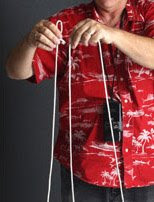
Way back in the day, when old-skool lighting guru Jon Falk (Adventures in Location Lighting) talked about "strobe on a rope" he meant severing the flash tube and using it with an extension cord for extreme flexibility.
When I travel with the family, I try to strike a balance between having enough gear with me to make nice photos and not feeling like a pack mule. I frequently guess wrong on the "how much to bring" question, but it usually comes down to a tight SLR bag (with an off-camera light kit) or a Canon G9.
Earlier this summer, I drove down to Florida with Susan and the kids to visit my parents. I brought along a camera, a coupla small flashes and an idea for a photo I wanted to make for the upcoming 50th anniversary of my parents' first date. It was to be a family photo, but I wanted to approach it just as seriously as if I had gotten the job from a national magazine.
Mom and dad have retired to the shores of Lake Billy Boohoo, just north of the sprawling metropolis of Umatilla, Florida. (Population: Not very many.)
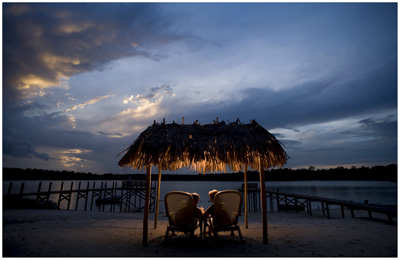
No, I am not making that lake name up, either. Some kid, presumably named Billy, drowned there in the 1950's and the name stuck. The sunset above is typical of the beautiful, subtropical displays they get in the evening.
Note to self: If I ever buy lakefront property in Florida, buy on the east side for the view. I only see sunrises when I am up too late from the night before.
Personally, I could probably go twenty years without getting the idea to build a private "tiki hut." But then, I am not my parents, living on this lake, with some serious time to kill. So that's what they did.
When they told me about it last winter, I knew I wanted to photo them in the hut against a sunset. When I learned that they were coming up on the 50th anniversary of their first date (in the 8th grade) I figured this summer's trip would be a perfect time to shoot them.
If you are a long-time reader of this site, I hope the gears are already turning. Pop some nice flash against that sunset (maybe in an umbrella, warming gel, etc.) and Bob's your uncle. Problem is, Westcott double-fold shoot-thru's do not normally live on beaches. And while the light might look nice, it would not really make sense.
Motivated light is one of the keys to getting believability and logic in your lit photos. Where would the light come from? What would the light look like?
Those are questions you should be asking yourself before you design the light in your photos if you want to hold a visual narrative.
So, I decided not to light for soft, flattering and warm but rather to emulate the light that would likely be in the tiki hut had dad run some electricity out there. (Give him enough time and he probably will, along with a computer terminal to check the weather a few hundred times a day...)
Presto: One bare tungsten light bulb, albeit much more controllable.
The first test, above, shows where the light is mounted. I decided to just flood them from overhead with some "tungsten" light, and balance the flash with the sunset. A quick pop shows that I can get a clean 5.6 at half power, which is pretty good considering the diffuser and the gel both eat a lot of light.
So that gives me my working aperture. But the sky is too bright at my sync speed to look good at this point.
How do you fix that? You wait. Or you cheat.
This shot was taken at a 500th of a second -- a full stop past the normal top sync speed. Sure, I could go with focal plane high speed sync. But that robs power from the flash, and I needed power.
So, how to sync at a 500th? No problem if you do not need the whole frame to be flashed. My SB-800 was just lighting the bottom part of the frame, so no big whup cheating the sync for this shot.
Since the "black stripe" creeps in from the bottom of my photo, I did turn the camera upside down to cheat this one. If the flash would have needed to light the whole frame, you would have seen that it was dark in the upper half, due to incorrect synching.
So now I waited for the ambient level to come to me. But while I waited, I decided to shoot the final photo at 1/320th of a second, to use that small, "no-synch" bar to seal off the flash from the bottom of my photo. (Camera right-side up for that one.)
It feathered the flash nicely, and kept the bright part from leading your eye out of the frame. __________
Here is the final shot, after the sunset came down to a level where 1/320th looked good against the correct (flashed) aperture. I love this photo, and will be making a nice print of it soon. (Click the pic to see it bigger.)
And given that you can vary the flash by fiddling with the aperture, and the sky by tweaking the shutter speed, I could have placed either tone anywhere I wanted. In this way, you get much more control through the shooting window than if there had been a real, continuous light bulb up in there.
Mom and dad wanted a shot from the side while I was at it, where you could see their faces better. Who am I to argue, except for the fact that I do not have an umbrella with me to diffuse the light. And besides, it is directly over their heads. Yuck.
My solution was to re-aim the light slightly, and take the diffuser off. I moved it to the front rail, aimed it a little forward and (mostly) balanced it off of the sand for a little over/under light.
It was the best I could do on short notice. But I think it looks kinda cool, considering. A little ham-fisted Photoshop session later and I was even able to clone the edges of the clamp out of the shot. (Couldn't really hide it from the side.)
It's amazing what you can do with one little flash if you wait for the ambient to come to you. Even more so the other small-flash job we did down there, which was to shoot a series of real estate photos of the luxury log cabin next door -- with one SB-800.
On Friday, one hundred people left The Baltimore Sun -- 60 from the newsroom alone.
One of them was yours truly, having returned early from my one-year leave to take a buyout. There was a hard staff reduction quota in effect, and given the way the blog has gone I thought it would be best if I counted toward it when they started lopping off heads...
Over the next few months I will be working hard to shape my second career as a photographer. I have shot as a staffer for newspapers for twenty years, which gives me a wonderful breadth of experience. But in many ways, I am dating again after having been married for two decades.
I know that many people who read this site are amateurs who are at least toying with the idea of going pro in one way or another. I also know that there are PJ readers who either are -- or will be -- facing hard cuts in the newsroom. In that sense, we now have much in common.
So I will be going through the growth process fishbowl-style, in the hopes that the shared experience might be helpful to those of you who are toying with the idea of going pro and wondering how to approach it.
Fortunately, the headline is, for me, somewhat tongue-in-cheek. I am not worried about whether or not I'll have a job. The website -- many thanks to all of you -- offers some breathing room on the financial side of things. But I have always been a photographer, and that is what I want to continue to be.
The question is, what now? Who I will be shooting for? What will I be shooting?
Who knows. I'll be curious to see where the combination of shooting and writing about it takes me.
Newspapers are facing hard times these days. Printing news on dead trees is tough row to hoe in 2008. From here, survival wll be determined by how fast -- and how well -- papers can migrate their readership to the web.
And as for the people who left The Sun this week, rest assured that that they did not go quietly into the night:
Best of luck to all of my friends and colleagues who are entering the next phase of their lives. Please write when you find work.
A little while back I did some surveying on this site. Among other things, the survey told me that the readership of Strobist skewed male. Overwhelmingly, pathetically, ninety-four-percentingly male.
So I am thinking today that roughly six percent of you will react to Hamish's shotgunned beer burp with an "Ewww, gross," while about 94 percent of you will hold up signs with ratings from one to ten.
Vancouver-based shooter Martin Prihoda is back, squeezing a little end-of-day fun out of some lighting gear rental, and walking through the process of shooting a guy in a monkey suit against a sunset.
And when we say "monkey suit" we are not talking about a tuxedo.
Having spent much of my 20 years as a newspaper shooter with sticky-velcro-covered flashes, I have recently become a big fan of velcro speed straps for mounting all of my light mods to small flashes.
Hit the jump for why you want 'em, where to get 'em, and how to make 'em -- plus a whole mess of archive DIY links. _________
At one point in the 1980's, I think my go-to SB-24 had so much velcro stuck to it that it looked like a burnt Chia Pet. The problem with the stick-on velcro is if when it wears out, it doesn't hold worth a crap. And it is a pain in the butt to unpeel and swap. To that, add the fact that you have a limited amount of surface area unless you want your flash to look like mine did.
With all of today's lighting mod options, you really want to have some kind of velcro mounting system on your flash. And the speed strap route is the way to go -- you can easily remove them and/or swap out for a new one if the velcro goes. Plus you get a whole lot more mounting real estate, compared to the typical amount of stuck-on velcro.
Truth be told, these little guys are not expensive. They are less than $10, so many of you may well choose to go store-bought in this instance. You can get them from LumiQuest ($6.95 - smaller size) or from HonlPhoto ($9.95 - bigger, w/more surface area and grip).
They are the basis for most light mods mounting systems, including those from LumiQuest and HonlPhoto. Quest Couch from LumiQuest notes that, for larger light mods, you can use two straps (strobe - strap - light mod - second strap on top) for a super strong hold.
If you just use one or two strobes, it probably makes sense to tap the Visa card. But if you are broke have a whole case of strobes and would be buying straps by the half dozen, you might want to consider making them. They are cheap and easy, especially of you wait until the next time your bike inner tube goes flat.
To make them, you'll be using the inner tube as a base. It's cheap, holds well and is nice and wide.
You can make a strap in less than five minutes, using the inner tube and some sticky velcro (available at craft and hardware stores.)
1. Cut your tube into sections long enough to fully wrap around the head of your flash with a full overlap on the wide dimension. Go a little long, then you can cut it for an exact fit when you are done.
2. Cut a length-wise strip from the tube, making a flat piece of rubber about an inch-and-a-half wide. There will probably be injection mold lines along the tube to make for easy, straight cuts. Mountain (and trail) tubes work better than the smaller road bike tubes. If you use the portion of the tube that would come in contact with the ground (if it were a tire) you'll avoid the curve of the rubber that would otherwise make it harder to fit.
3. Very important: Wash the rubber thoroughly with soap and water, and dry it well. It will have grime on it, and a powder residue on the inside -- both of which will cause problems if it is not clean and dry.
4. Totally cover the inside of the rubber section with two long strips of the "loops" part of the velcro. Trim along the edges to fit if necessary.
5. Cover the other side of the tube (formerly the outside) with "hooks" velcro at one end, to a length equal to the width of your flash head.
6. Wrap the strap around your flash, overlapping on the long end, and trim to length if necessary.
That's all there is to it.
Here's a view of the reverse side, which should make everything self explanatory. It's very important to make sure the tube section is totally clean and dry, or your sticky velco won't hold.
Normally, when I run a DIY post I get a few condescending comments from the deep-walleted DIY haters, which serve to offset the comments I get from the starving artists when I mention, say, Profotos. So, as long as they are gonna be pissed off anyway, here are lots more DIY posts dusted off from the archives: ___________
If you missed out on the Strobist Lighting Seminar DVD set, the second printing is in. All backorders have now been shipped, and remaining DVDs are available here.
 Are you female?